
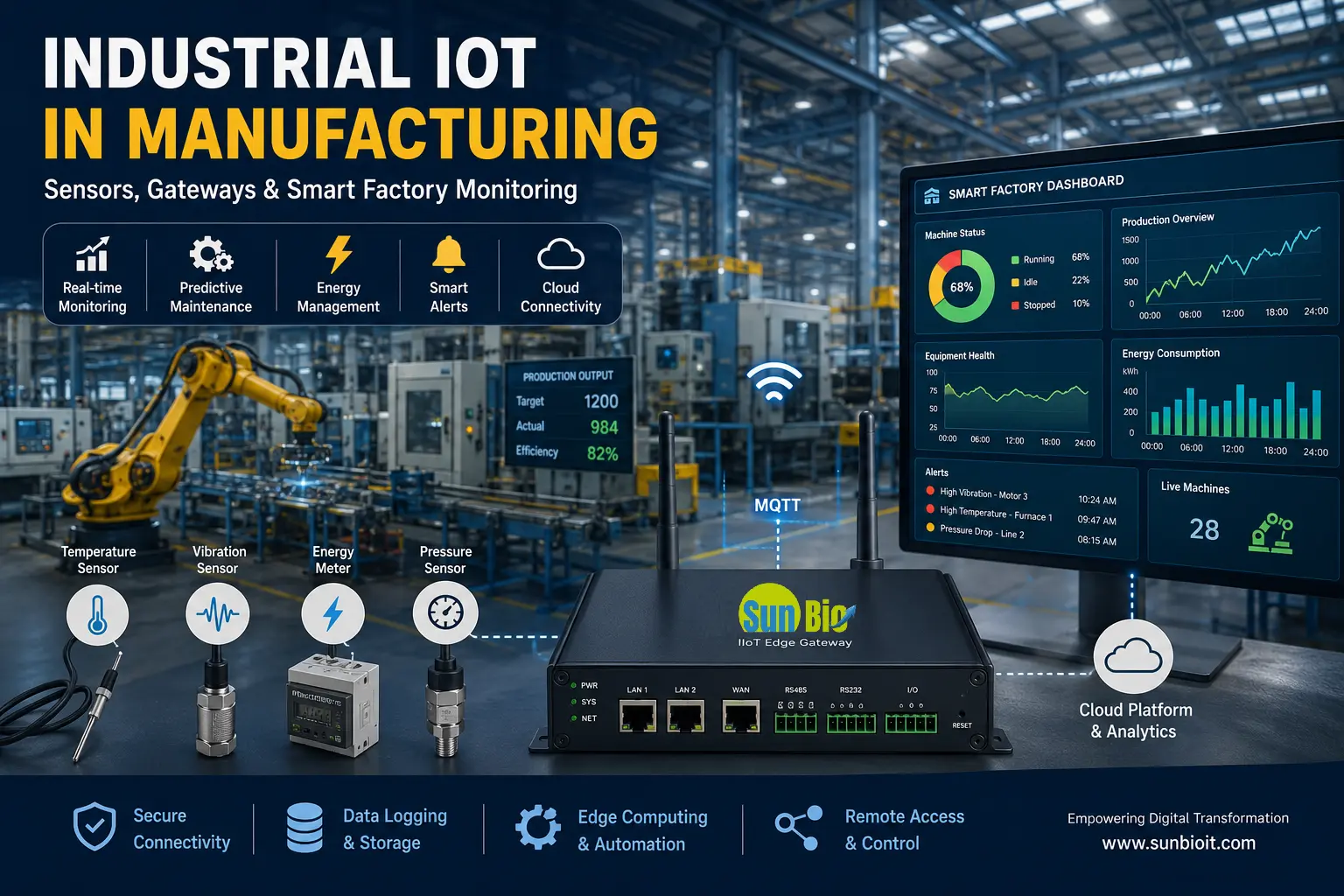
Industrial IoT in Manufacturing: Sensors, Gateways & Smart Factory Monitoring
Manufacturing industries are increasingly adopting connected technologies to improve production visibility, monitor equipment performance and make better operational decisions. One of the most important technologies driving this transformation is Industrial Internet of Things (IIoT).
Industrial IoT connects factory machines, industrial sensors, programmable logic controllers (PLCs), meters and monitoring systems through connected networks. It allows manufacturers to collect operational data, monitor equipment remotely and identify potential problems before they interrupt production.
For manufacturing companies looking to move towards Industry 4.0, Industrial IoT provides an important foundation for smarter, more connected operations.
In this guide, we explore how Industrial IoT works in manufacturing, the technologies involved, practical industrial applications and how businesses can approach IIoT implementation.
1. What Is Industrial IoT (IIoT)?
Industrial Internet of Things (IIoT) refers to the use of connected sensors, machines, communication networks and software platforms to collect and exchange industrial operational data.
Unlike traditional industrial monitoring, where operators may need to check individual machines manually, Industrial IoT enables equipment data to be collected and viewed through centralized monitoring systems.
For example, an industrial facility can use connected sensors to monitor:
- Machine temperature
- Equipment vibration
- Motor operating conditions
- Production machine status
- Energy consumption
- Pressure and flow measurements
- Environmental conditions
This information can help production teams understand equipment performance, identify unusual operating conditions and improve maintenance planning.
Industrial IoT is an important component of Industry 4.0 because it connects physical manufacturing operations with digital monitoring and analytics systems.
2. Why Manufacturing Industries Need Industrial IoT
Traditional manufacturing facilities often face operational challenges because machine information is distributed across different equipment, control panels and manual records.
Industrial IoT helps address these challenges by providing connected data and centralized visibility.
Improved machine visibility
Connected sensors and industrial gateways can collect machine operating data and make it available through centralized dashboards.
Operators can monitor equipment conditions without checking every machine individually.
Reduced unplanned downtime
Monitoring parameters such as vibration and temperature can help maintenance teams identify unusual equipment behaviour.
When abnormal readings are detected, alerts can help teams investigate potential problems before they become major operational interruptions.
Better production monitoring
Connected systems can collect machine status and production-related information to help supervisors understand operational performance.
Improved energy management
Industrial energy meters and monitoring devices can provide information about electricity consumption and operating patterns.
This information can help identify opportunities for energy optimization.
Remote equipment monitoring
Depending on the connectivity architecture, authorized personnel can view equipment information remotely without being physically present at every monitoring location.
3. How Industrial IoT Works in a Smart Factory
An Industrial IoT system generally consists of five important layers.
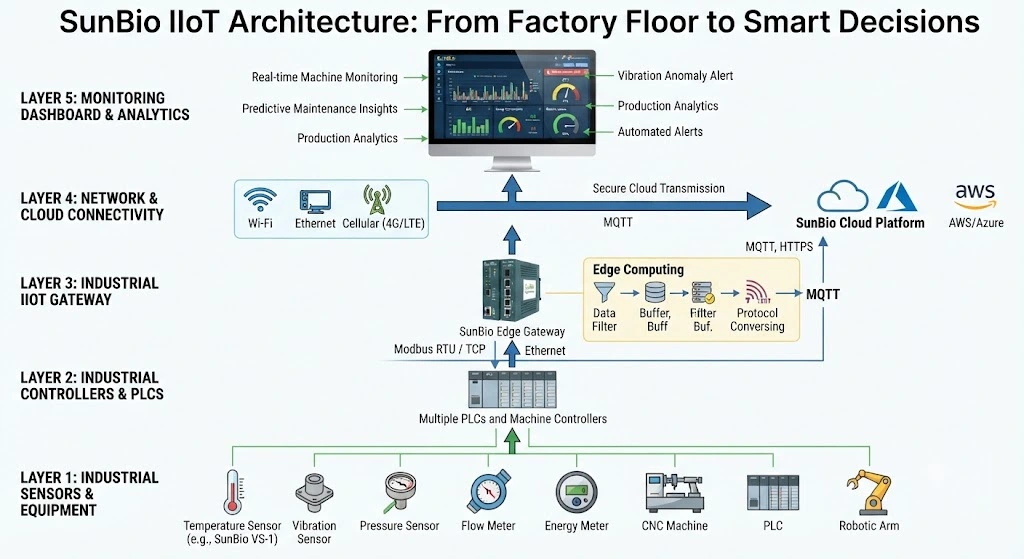
Layer 1: Industrial Sensors and Equipment
Sensors collect physical measurements from machines and the surrounding environment.
Common examples include:
- Temperature sensors
- Vibration sensors
- Pressure sensors
- Humidity sensors
- Current sensors
- Flow meters
- Energy meters
These devices convert physical measurements into data that can be processed by connected systems.
Layer 2: Industrial Controllers and PLCs
PLCs and industrial controllers manage machine operations and collect equipment information.
They can provide machine status, process values, alarms and other operational information to connected monitoring systems.
Layer 3: Industrial IIoT Gateway
An Industrial IoT gateway acts as a communication bridge between factory equipment and digital platforms.
It can collect information from multiple industrial devices, convert supported communication protocols and transmit operational data to monitoring platforms.
For example, an industrial gateway may connect equipment using Modbus RTU or Modbus TCP and transmit the collected information using MQTT.
Layer 4: Network and Cloud Connectivity
Collected data can be transmitted through Ethernet, Wi-Fi or cellular connectivity, depending on the installation.
Communication protocols such as MQTT and HTTPS help transfer information between connected equipment and software platforms.
Layer 5: Monitoring Dashboard and Analytics
The final layer presents collected information through dashboards, reports and alerts.
Manufacturing teams can use this information to monitor equipment conditions, review operational trends and make informed decisions.
Typical Industrial IoT architecture:
Sensors and Machines → PLC / Industrial Controller → IIoT Gateway → MQTT / Network → Cloud Platform → Dashboard and Alerts
4. Important Technologies Used in Industrial IoT
A successful Industrial IoT implementation depends on selecting appropriate hardware, communication protocols and software architecture.
Industrial Sensors
Industrial sensors collect real-time measurements from manufacturing equipment.
Temperature and vibration sensors are particularly useful for equipment condition monitoring.
Other sensors can measure pressure, humidity, electrical parameters and fluid flow.
Industrial IIoT Gateways
Industrial gateways connect different types of industrial equipment to centralized digital systems.
Important gateway capabilities include:
- Industrial communication protocol support
- Local data processing
- Secure data transmission
- Network connectivity
- Local data buffering
- Remote monitoring integration
MQTT Communication
MQTT is a lightweight messaging protocol commonly used in connected IoT applications.
It uses a publish-and-subscribe architecture.
For example, an industrial monitoring device can publish temperature information to an MQTT topic, while an authorized monitoring application subscribes to that topic to receive updates.
MQTT is particularly useful when connecting multiple devices across distributed industrial locations.
Modbus Communication
Modbus is widely used for communication between industrial controllers, meters and automation equipment.
Common implementations include:
- Modbus RTU over serial communication
- Modbus TCP over Ethernet
An IIoT gateway can collect information from compatible Modbus devices and make that information available to higher-level monitoring applications.
Edge Computing
Edge computing processes selected information close to the machines rather than sending every operation directly to a remote platform.
Depending on gateway capabilities, edge processing can support:
- Local threshold monitoring
- Data filtering
- Equipment alerts
- Local automation rules
- Temporary data storage
This can help reduce unnecessary data transmission and improve responsiveness.
5. Five Practical Industrial IoT Applications in Manufacturing
5.1 Real-Time Machine Monitoring
Machine monitoring provides visibility into equipment operating conditions.
Industrial sensors and connected controllers can provide information such as temperature, vibration, machine status and operating hours.
Production supervisors can use this information to identify abnormal operating conditions and understand equipment utilization.
5.2 Predictive Maintenance
Unexpected equipment failures can interrupt production and increase maintenance costs.
Industrial IoT supports condition monitoring by continuously collecting equipment measurements.
For example, increasing vibration levels or unusual temperature changes may indicate that equipment requires inspection.
When combined with historical data and suitable analytics, these measurements can support predictive maintenance strategies.
It is important to note that sensor alerts alone do not guarantee accurate failure prediction. Reliable predictive maintenance requires appropriate data, analysis and validation.
5.3 Production Monitoring
Manufacturing facilities can connect machine controllers and production equipment to collect operational information.
This can help teams understand:
- Machine running and idle time
- Production cycles
- Equipment availability
- Production interruptions
- Operating trends
The collected information can support production planning and process improvement.
5.4 Energy Monitoring
Industrial energy monitoring systems collect electrical measurements from compatible meters and monitoring devices.
Manufacturers can review consumption patterns, compare operating periods and identify equipment that may require energy optimization.
5.5 Environmental and Facility Monitoring
Connected temperature, humidity and other environmental sensors can help monitor conditions in manufacturing facilities, storage areas and industrial infrastructure.
This is particularly useful when environmental conditions need to be monitored continuously.
6. Why an Industrial IoT Gateway Is Important
Industrial equipment often uses different communication protocols and interfaces.
Connecting all these devices directly to a cloud platform is not always practical.
An Industrial IIoT gateway helps bridge this gap.
A suitable gateway can:
- Collect information from connected industrial devices.
- Support communication with compatible PLCs and sensors.
- Convert supported industrial protocols.
- Process or filter selected information locally.
- Transmit data through MQTT or other supported protocols.
- Buffer information during temporary network interruptions.
SunBio Industrial IIoT Gateway
SunBio IT Solutions provides an Industrial IIoT Edge Gateway designed for industrial connectivity and smart manufacturing applications.
The gateway product page describes capabilities including:
- Modbus RTU and Modbus TCP communication
- OPC UA support
- MQTT and HTTP/HTTPS connectivity
- RS-485 and Ethernet interfaces
- Local store-and-forward data logging
- Edge computing and local automation rules
- Optional 4G/LTE and Wi-Fi connectivity
- Industrial DC power input
These capabilities can support connectivity between compatible factory equipment and centralized monitoring platforms.
Learn more about the SunBio Industrial IIoT Gateway.

7. How to Implement Industrial IoT in a Manufacturing Facility
Industrial IoT implementation should begin with a clearly defined operational requirement rather than installing sensors without a specific purpose.
Step 1: Identify the Monitoring Requirements
Identify which machines, production processes or industrial parameters need monitoring.
For example, a manufacturing facility may initially focus on monitoring motor temperature and vibration.
Step 2: Select Appropriate Sensors
Choose sensors according to the measurement requirements, environmental conditions and equipment specifications.
Step 3: Evaluate Existing Industrial Equipment
Identify the available PLCs, controllers, meters and communication interfaces.
Check which protocols are supported by the existing equipment.
Step 4: Select an Appropriate IIoT Gateway
Choose a gateway that supports the required industrial protocols, interfaces, data processing and connectivity options.
Step 5: Configure Data Communication
Configure the communication between sensors, PLCs, gateways and monitoring applications.
Ensure that device identification, data formats and communication settings are consistent.
Step 6: Develop the Monitoring Dashboard
Present important measurements through a centralized dashboard.
Configure suitable alerts for abnormal operating conditions.
Step 7: Test and Expand
Start with a limited implementation, validate the data and connectivity, and gradually expand to additional machines and production areas.
8. Industrial IoT and Industry 4.0: What Is the Difference?
Industrial IoT and Industry 4.0 are closely related, but they are not identical.
Industrial IoT focuses on connecting industrial equipment, collecting operational data and enabling communication between machines and software systems.
Industry 4.0 is a broader manufacturing transformation approach that combines connected equipment, automation, analytics, artificial intelligence and integrated production systems.
Industrial IoT provides an important connectivity foundation for Industry 4.0.
Explore how SunBio supports Industry 4.0 and smart manufacturing.
9. Choosing the Right Industrial IoT Solution
Before selecting an Industrial IoT solution, manufacturing companies should evaluate several technical considerations.
| Evaluation area | What to consider |
|---|---|
| Sensor compatibility | Required measurement ranges and interfaces |
| Protocol support | Modbus RTU, Modbus TCP, MQTT, OPC UA |
| Gateway capability | Processing, connectivity and data buffering |
| Network security | Authentication, encryption and access control |
| Scalability | Number of devices and future expansion |
| Dashboard | Monitoring, reporting and alerts |
| Integration | Compatibility with existing systems |
| Maintenance | Device diagnostics and long-term support |
A properly designed solution should match the facility’s operating requirements and existing industrial infrastructure.
Security should also be considered from the beginning. Industrial devices should use controlled network access, appropriate authentication, encrypted communications where supported and secure configuration practices.
10. Frequently Asked Questions About Industrial IoT
What is Industrial IoT in manufacturing?
Industrial IoT in manufacturing refers to connecting machines, industrial sensors, controllers and monitoring applications to collect and analyze operational data.
What is the purpose of an Industrial IoT gateway?
An Industrial IoT gateway connects industrial devices to digital platforms. It can collect equipment information, support protocol conversion and transmit data to centralized monitoring systems.
Which communication protocols are used in Industrial IoT?
Common protocols include MQTT, Modbus RTU, Modbus TCP, OPC UA and HTTP/HTTPS. The appropriate protocol depends on the equipment and application requirements.
How does Industrial IoT help predictive maintenance?
Industrial IoT collects equipment measurements such as temperature and vibration. Historical data and suitable analytics can help identify abnormal operating patterns and support maintenance planning.
Can Industrial IoT connect existing factory machines?
Yes. Existing machines can often be connected using compatible PLC interfaces, industrial communication protocols and suitable gateways. The feasibility depends on the equipment’s available interfaces and data access.
Is Industrial IoT suitable for small manufacturing industries?
Yes. Small and medium-sized manufacturing facilities can begin with a limited monitoring project, such as connecting a few critical machines, and expand as operational requirements grow.
What is the difference between IoT and IIoT?
IoT covers connected devices across many applications, including homes, agriculture and businesses. IIoT specifically focuses on industrial equipment, manufacturing processes and industrial operations.
11. Build Smarter Manufacturing Operations with SunBio IT Solutions
Industrial IoT is helping manufacturing companies move towards connected, data-driven and intelligent operations.
From industrial sensors and edge gateways to connected monitoring systems, the right technology architecture can improve equipment visibility and provide valuable operational insights.
SunBio IT Solutions Private Limited, established in 2012, delivers technology solutions across Industrial IoT, Industry 4.0, AI/ML, industrial automation and Smart Agriculture.
If your organization is planning to connect factory equipment, implement machine monitoring or explore Industrial IoT gateway solutions, connect with the SunBio team.
Explore SunBio Solutions:
- Industrial IoT Solutions
- Industrial IIoT Gateway
- Industrial Automation Services
- Industry 4.0 Solutions
Contact SunBio for Industrial IoT Solutions
Connect your machines. Monitor your operations. Build a smarter factory with Industrial IoT.
Leave a Reply