
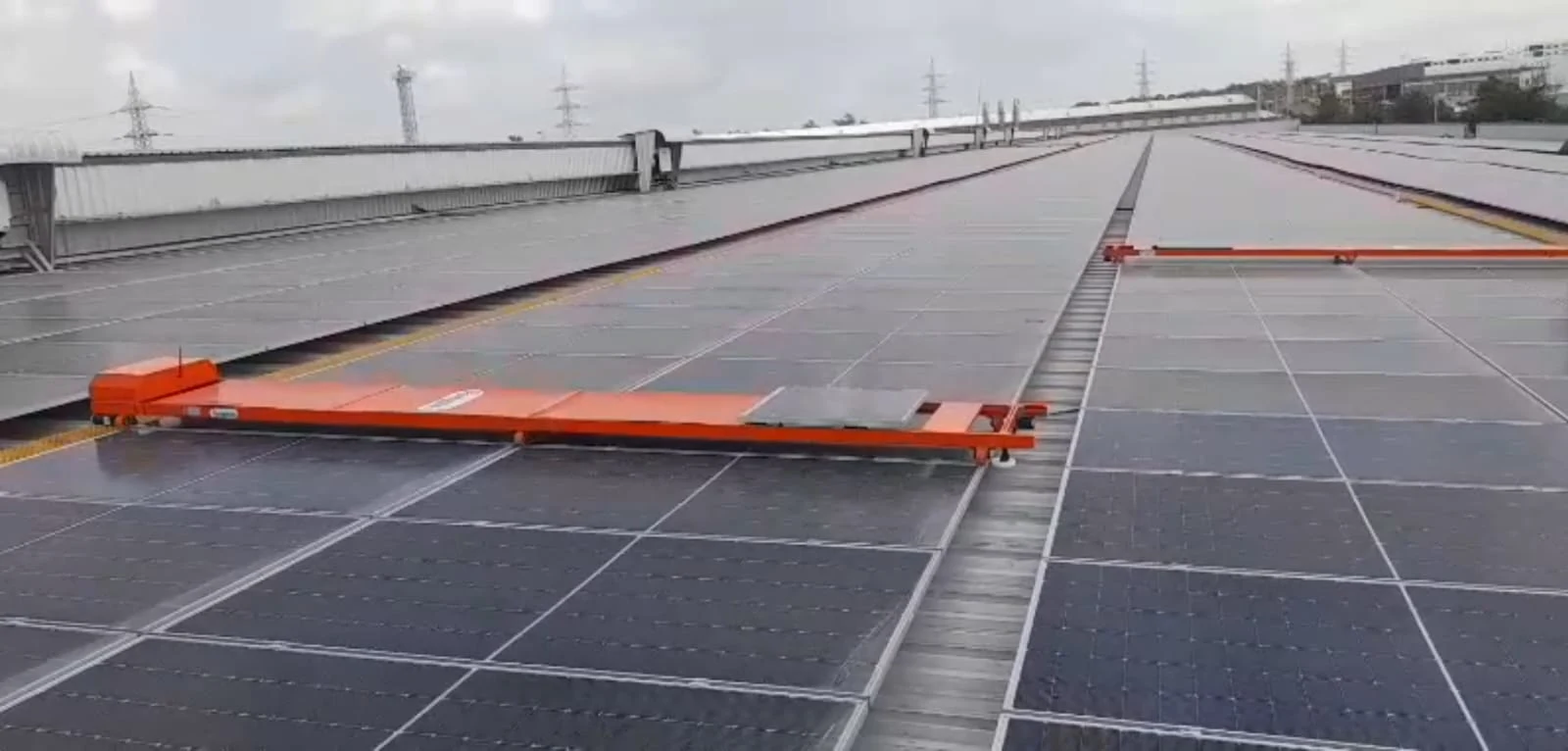
SunBio IT Solutions deployed an advanced [IoT solar panel cleaning](https://www.sunbioit.com/internet-of-things) system that automates maintenance, optimizing safety and photovoltaic performance for Aegus Pvt Ltd.
Client: Aegus Pvt Ltd
Industry: Renewable Energy & Solar Infrastructure Automation
Core Technologies: [IoT Automation](https://www.sunbioit.com/internet-of-things), Cloud Telemetry, LiDAR & Ultrasonic Sensors, [Smart Power Management](https://www.sunbioit.com/industrial-iiot-gateway)
Executive Summary
Aegus Pvt Ltd, a leader in renewable energy generation, faced critical operational bottlenecks and intense safety hazards while maintaining utility-scale solar farms. By partnering with SunBio IT Solutions, Aegus engineered a fully autonomous, [IoT-enabled solar panel cleaning system](https://www.sunbioit.com/internet-of-things) designed to minimize on-site risk, maximize photovoltaic performance, and enable centralized remote supervision.
The Challenge
High-Risk Manual Operations & Limited Scalability
Manual cleaning across expansive solar panel arrays introduced critical structural and financial roadblocks:
- Severe Safety Hazards: Manual work at elevated heights increased fall risks, equipment handling hazards, and extreme heat exposure for technicians.
- Inconsistent Cleaning Efficiency: Inconsistent manual washing led to uneven dust and soiling removal, directly suppressing overall solar power yields.
- High Labor Expenditure: Routine maintenance required multiple on-site technicians and continuous supervisor oversight.
- Poor Scalability: Heavy human dependency restricted rapid expansion and scaling across large-scale solar infrastructure.
The Solution
IoT-Based Autonomous Solar Cleaning System
SunBio IT Solutions implemented a robust, autonomous IoT infrastructure leveraging [industrial automation services](https://www.sunbioit.com/industrial-automation-services) to replace manual labor and optimize energy production:
- Intelligent Sensor Suite: Integrated LiDAR and ultrasonic sensors for precise obstacle avoidance and safe navigation across complex panel arrays.
- Real-Time Cloud Telemetry: An IoT-enabled dashboard providing live operational monitoring, alerts, and performance metrics.
- Remote Operation & Control: Centralized scheduling and equipment configuration manageable seamlessly via desktop or mobile interfaces.
- Smart Power Management: Optimized, autonomous battery utilization capable of sustaining complete, uninterrupted cleaning cycles.
Results & Impact
Zero Safety Incidents and 50% Faster Cleaning Cycles
| Metric | Before Automation | After Automation | Improvement |
| Safety Incidents (at height) | Moderate Risk | Zero Risk | 100% Risk Elimination |
| Cleaning Cycle Time | 8 hrs (Manual) | 4 hrs (Autonomous) | 50% Faster |
| Labor Cost | 2 Supervisors/site | 0.1 Remote Operator | 95% Reduction |
| Energy Loss (Soiling) | 4–6% | <1% | +5–7% Uptime |
By automating the entire workflow, Aegus successfully eliminated physical safety incidents, protected hardware integrity, maximized clean energy generation, and drastically reduced day-to-day operating expenses (OPEX).
Next Phase
AI-Driven Predictive Maintenance & SCADA Integration
- Predictive Scheduling: Deployment of machine learning models to determine optimal cleaning cycles based on real-time local soiling patterns and weather forecasts.
- SCADA Integration: Seamless linkage of real-time cleaning metrics with broader solar farm SCADA and performance monitoring networks.
Frequently Asked Questions (FAQs)
How does an autonomous solar panel cleaning system work?
An autonomous solar panel cleaning system uses IoT automation, intelligent LiDAR and ultrasonic sensors for obstacle avoidance, and smart power management to clean utility-scale photovoltaic arrays without manual labor at heights.
What are the benefits of IoT automation in renewable energy infrastructure?
IoT automation eliminates high-risk manual labor, reduces cleaning cycle times by up to 50%, minimizes labor overhead, and prevents power output losses caused by dust and soiling accumulation.
Conclusion
The successful deployment of SunBio IT Solutions’ IoT-enabled autonomous cleaning infrastructure marks a massive leap forward for Aegus in the renewable energy sector. By entirely eliminating high-risk manual labor at heights, slashing cleaning times in half, and boosting energy uptime by up to 7%, this case study proves how intelligent automation and smart sensor integration can redefine utility-scale solar maintenance, ensuring maximum photovoltaic efficiency and sustainable, scalable growth.
Interested in renewable energy automation solutions? Contact SunBio IT Solutions to discuss your custom infrastructure requirements.