
Industry: Manufacturing, Industrial Automation & Smart Factory
Solution: AI Automation, Industrial IIoT Gateway & Machine Data Integration
Technologies: Industrial IoT, AI Analytics, PLC, Modbus RTU/TCP, MQTT, OPC UA, Edge Computing
Solution Provider: SunBio IT Solutions Private Limited
1. Executive Overview
Modern manufacturing plants are rapidly adopting smart manufacturing, AI automation, and Industry 4.0 practices. However, many shop floors still run legacy machinery, Programmable Logic Controllers (PLCs), drives, and sensors in isolated silos without unified telemetry or automated analytics.
When machine running states, fault registers, cycle durations, and sensor streams remain disconnected, supervisors and maintenance engineers face blind spots. Unplanned stoppages go uncategorized until shift-end sheets are compiled, subtle mechanical wear goes unnoticed until a breakdown halts production, and AI models lack clean, high-frequency operational data.
SunBio IT Solutions bridges this gap by pairing Industrial IIoT Gateways with edge data processing, centralized databases, and AI Automation—enabling factories to modernize brownfield equipment without ripping and replacing core production machinery.
2. Real Shop-Floor Problems & Root Causes
In real-world multi-vendor manufacturing environments, operational losses rarely stem from a single issue. Instead, they compound across protocol fragmentation, manual reporting lag, silent micro-stoppages, and unmonitored sensor drift.
| Real Shop-Floor Problem | Underlying Technical / Operational Cause | Impact on Factory Operations |
|---|---|---|
| Protocol & Vendor Silos | Mixed PLC brands, legacy serial controllers, and newer Ethernet/IP or OPC UA devices speaking incompatible dialects. | Data stays trapped inside local machine panels; cross-line comparison is slow or impossible. |
| Lagging Manual Shift Logs | Operators record counts, idle reasons, and faults on paper or spreadsheets at shift handovers. | Delayed root-cause visibility, transcription errors, and missing micro-downtime events. |
| Silent Micro-Stoppages & Cycle Creep | Brief 15–90 second jams, feed delays, or gradual cycle-time slowdowns go unlogged. | Hidden capacity loss and missed OEE (Overall Equipment Effectiveness) targets. |
| Unplanned Breakdowns | Bearing wear, overheating motors/drives, or pressure/current drift is caught only at failure. | Emergency maintenance callouts, line stoppages, and delivery schedule slippage. |
| Network Drops & Data Gaps | Shop-floor Wi-Fi/LAN congestion or intermittent connectivity drops telemetry packets. | Incomplete historical datasets that degrade trend analysis and AI model reliability. |
3. Proposed Solution – Industrial IIoT Gateway + AI Automation
SunBio IT Solutions delivers an end-to-end architecture that normalizes machine signals at the edge, buffers data reliably during network blips, and feeds structured telemetry into centralized monitoring and AI analytics workflows.
- Multi-Protocol Machine Acquisition: Polls PLCs, CNCs, energy meters, and industrial sensors via Modbus RTU, Modbus TCP, OPC UA, and supported field interfaces.
- Edge Computing & Store-and-Forward Buffering: Validates tags, computes derived states (running, idle, fault, cycle time), and caches records locally if upstream links drop.
- Lightweight Industrial Messaging: Publishes structured payloads over MQTT to centralized ingestion services and time-series / relational databases.
- AI Anomaly Detection & Predictive Scoring: Evaluates real-time and historical patterns to flag abnormal vibration, thermal rise, current spikes, or recurring faults early.
- Actionable Dashboards & Alerts: Surfaces live KPIs, shift reports, and automated email/messaging/dashboard alerts to maintenance and production teams.
4. System Architecture
The architecture connects shop-floor machinery to centralized analytics through four logical layers—moving machine telemetry upstream via the Industrial IIoT Gateway and routing insights, alerts, and control workflows back to operations and AI Automation logic.
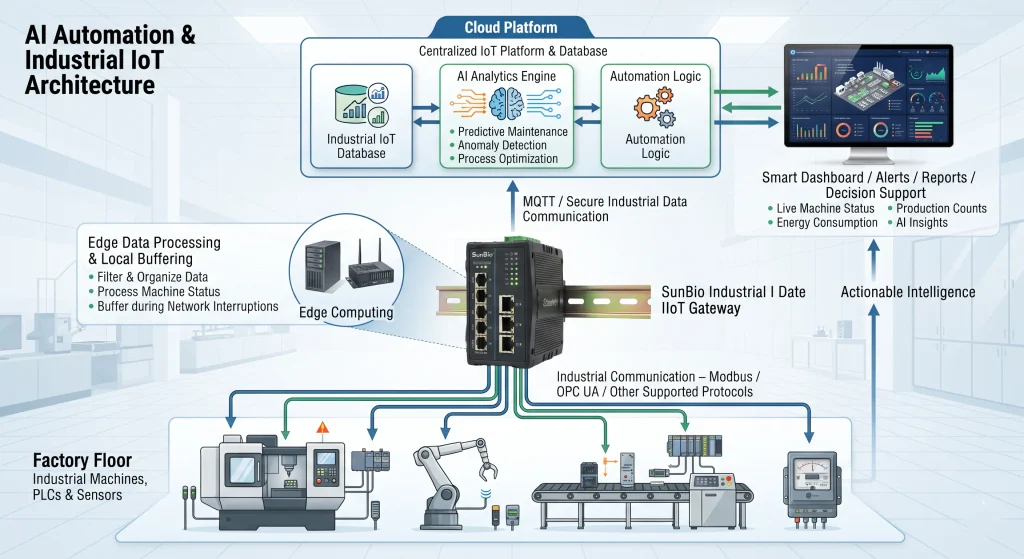
Layer 1 – Shop Floor & Field Devices: Industrial Machines, PLCs, CNCs, Meters & Sensors
↕ (Modbus RTU/TCP, OPC UA & Supported Field Protocols)
Layer 2 – Edge Gateway & Buffering: SunBio Industrial IIoT Gateway → Tag Normalization, Edge Rules & Local Store-and-Forward Buffer
↓ (MQTT / Secure Industrial Telemetry Transport)
Layer 3 – Platform, Storage & AI Engine: Centralized IoT Platform & Database → AI Analytics, Anomaly Scoring & Automation Logic
↓ (Real-Time Feeds, Webhooks & Scheduled Exports)
Layer 4 – Application & Decision Layer: Smart Dashboards, Automated Alerts, Shift/Historical Reports & Operational Decisions
| Architecture Layer | Key Components | Primary Technical Function |
|---|---|---|
| 1. Field & Machine Layer | PLCs, production machines, energy meters, vibration/temp sensors | Generates raw operational signals, cycle pulses, fault codes, and process measurements. |
| 2. Edge & Connectivity Layer | SunBio Industrial IIoT Gateway (Modbus RTU/TCP, OPC UA, MQTT) | Polls field devices, normalizes tags, runs edge filtering/state logic, and buffers data during network outages. |
| 3. Data & AI Intelligence Layer | Centralized IoT platform, database, AI analytics & rules engine | Persists historical/real-time telemetry, scores anomalies/trends, and evaluates alert or automation conditions. |
| 4. Action & Insights Layer | Smart dashboards, email/messaging alerts, reports & decision support | Gives supervisors and engineers live OEE/status views, early warnings, and audit-ready production reports. |
5. Before vs. After Solution Comparison
The table below contrasts conventional, disconnected factory operations against a connected smart manufacturing workflow powered by the SunBio Industrial IIoT Gateway and AI analytics.
| Operational Dimension | Before Solution (Conventional Factory) | After Solution (Connected Smart Factory) |
|---|---|---|
| Machine & Line Visibility | Spot checks by floor staff; fragmented local HMI screens. | Centralized live status (Run, Idle, Fault, Offline) across connected machines. |
| Data Collection & Reporting | Manual logs at shift end; hours spent consolidating sheets. | Automated edge acquisition, MQTT streaming, and structured shift/historical reports. |
| Downtime & Fault Analysis | Broad or estimated stoppage reasons; recurring faults missed. | Timestamped stoppage events, cycle-time tracking, and fault-frequency trends. |
| Maintenance Strategy | Mostly reactive breakdowns or rigid calendar intervals. | Condition-aware monitoring and AI-assisted anomaly/early-warning alerts. |
| Alerting & Response | Discovered after output drops or parts are scrapped. | Near-real-time alerts on threshold breaches, cycle creep, or abnormal trends. |
| Network Resilience | Packets lost when plant network hiccups occur. | Edge local buffering retains data and syncs once connectivity recovers. |
6. How AI Automation Works in Manufacturing
Step 1: Machine Connectivity & Tag Acquisition
The Industrial IIoT Gateway interfaces with PLCs, CNC machines, packaging/conveyor lines, power meters, and external sensors to capture run/idle signals, production counts, cycle times, temperatures, pressures, motor current/power, vibration, and alarm codes.
Step 2: Protocol Normalization
Modbus RTU, Modbus TCP, OPC UA, and other supported interfaces are mapped into a consistent schema so diverse machines report uniform metrics to the platform.
Step 3: Edge Processing & Local Buffering
Edge logic filters noise, calculates machine states and cycle metrics, reduces redundant traffic, and buffers telemetry locally during WAN/LAN interruptions before forwarding over MQTT.
Step 4: AI-Based Pattern & Anomaly Analysis
Historical baselines and live streams are analyzed to spot subtle shifts—such as rising vibration harmonics, thermal drift under steady load, gradual cycle-time inflation, or repeated fault precursors.
Step 5: Automated Alerts & Intelligent Dashboard
Configured thresholds and AI risk scores trigger timely notifications via dashboard, email, or messaging systems while presenting live KPIs, energy usage, and fault histories in one place.
7. AI Prediction & Detection Score Benchmarks
In industrial AI deployments, prediction confidence and detection accuracy depend directly on sensor coverage (e.g., dedicated vibration/temperature sensors vs. PLC tags alone), sampling frequency, historical fault/normal data quality, and model maturity over time. The table below outlines indicative benchmark score ranges across common manufacturing use cases once properly calibrated.
| AI / Analytics Use Case | Primary Signals Used | Indicative Prediction / Detection Score Range | Key Factors Influencing Score |
|---|---|---|---|
| Machine State & Micro-Stoppage Detection | PLC status tags, cycle pulses, current draw | 92% – 98% | Clean digital/analog pulse timing; accurate debouncing rules. |
| Abnormal Thermal / Current Drift Detection | Temperature sensors, motor current/kW, load state | 85% – 94% | Steady operating-regime labeling; ambient temperature compensation. |
| Early Fault / Anomaly Warning (Predictive) | Vibration trends, cycle time variance, alarm history | 78% – 90% | Sampling rate, multi-cycle historical failure examples, sensor placement. |
| Cycle-Time Slowdown & Bottleneck Prediction | Station cycle durations, queue/idle intervals, throughput | 82% – 92% | Consistent shift/SKU metadata; separation of planned changeovers. |
| Energy Anomaly & Peak-Load Flagging | Smart meter kWh/kW/PF, active machine count | 86% – 95% | Meter accuracy, tariff/shift schedule alignment, baseline window length. |
Note: Indicative score ranges reflect typical target performance under well-instrumented conditions rather than a guaranteed SLA for every machine type. Models typically start with rule/statistical baselines and improve as labeled operational data accumulates.
8. Phased Industry 4.0 Rollout & Business Impact
Rather than attempting a risky big-bang overhaul, manufacturers achieve faster ROI by rolling out capabilities in stages:
- Phase 1 – Connect & Visibility: Deploy the Industrial IIoT Gateway, establish MQTT ingestion, and launch real-time machine status and production dashboards.
- Phase 2 – Baseline & Alerting: Build historical downtime/fault logs, energy tracking, and rule-based alerts for critical limits and stoppages.
- Phase 3 – AI Analytics & Optimization: Layer in anomaly detection, predictive maintenance scoring, and automated reporting workflows.
9. Why Choose SunBio IT Solutions?
SunBio IT Solutions Private Limited combines industrial edge connectivity, protocol integration, custom software engineering, and AI Automation to tailor solutions around your exact machines, network constraints, and production workflows.
- Industrial IIoT Gateway deployment & edge data processing
- PLC, sensor, and meter integration (Modbus, OPC UA, MQTT)
- AI anomaly detection, predictive maintenance & visual/image analytics
- Custom industrial dashboards, reporting & database integration
10. Conclusion
Turning raw factory signals into reliable telemetry and AI-driven insights allows manufacturers to cut unplanned downtime, eliminate manual reporting bottlenecks, and make faster, evidence-backed decisions on the shop floor.
Connect your machines. Collect meaningful data. Build an intelligent factory.
Transform Your Factory with AI Automation & Industrial IoT
Planning to connect existing PLCs and machines, automate production tracking, or pilot AI predictive analytics on your shop floor?
SunBio IT Solutions Private Limited
Connect with us to scope a customized Industrial IIoT & AI Automation solution