
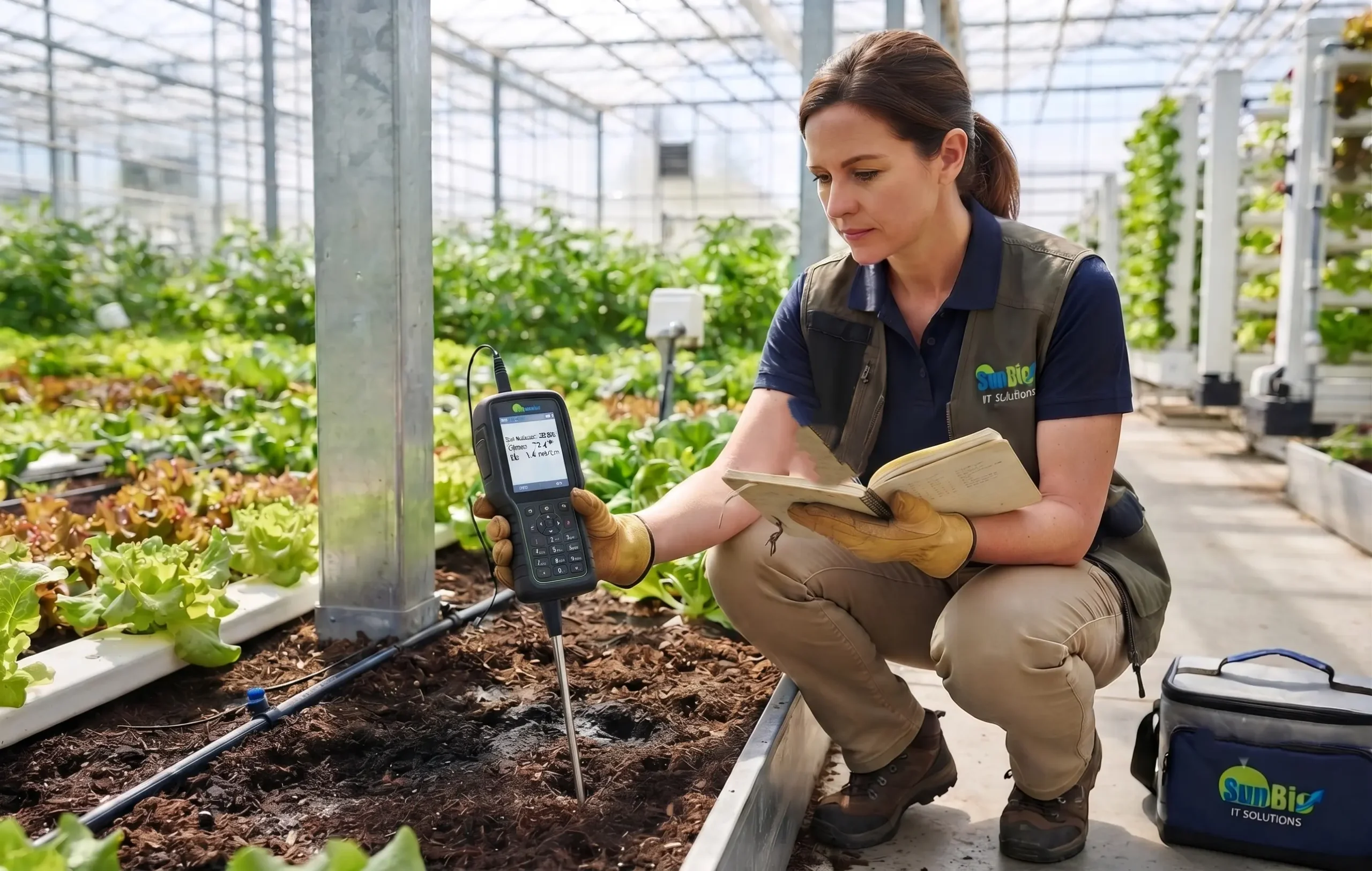
In modern precision agriculture, resource management and real-time data tracking have become vital for maximizing crop yields while conserving water. Traditional farming methods often rely on manual guesswork, frequently leading to over-irrigation, nutrient leaching, and higher operational costs. To overcome these challenges, commercial growers and agronomists are turning to advanced automated solutions like the Soil Moisture Sensor.
SunBio IT Solutions stands at the forefront of this agricultural evolution, integrating intelligent IoT monitoring systems, high-frequency dielectric probes, and automated telemetry to help farms transition from conventional practices to fully connected smart ecosystems.
Why Choose Research-Grade Soil Moisture Sensors Over Hobbyist Modules?
Many basic hobbyist electronics kits and introductory projects utilize low-cost resistive modules (such as the YL-69). These sensors expose bare metal pins directly to the soil, passing a direct DC current to measure resistance. However, in real-world agricultural environments, this method creates major issues:
- Electrolysis and Corrosion: Direct DC current causes rapid galvanic corrosion, meaning sensor pins rust and degrade within weeks of deployment in damp soil.
- Salinity Sensitivity: Fertilizer salts and mineral ions skew electrical readings, giving false high moisture percentages.
The Capacitive Advantage
Professional-grade soil moisture sensors solve this by utilizing high-frequency dielectric capacitance technology. An insulated probe creates a localized alternating electric field around 316 stainless steel pins, measuring the soil’s charge-storing capacity without causing electrolysis or reacting to salt ions. Fully encapsulated in IP68 waterproof epoxy, these sensors are built for multi-year commercial reliability.
Core Metrics: Volumetric Water Content vs. Water Potential
To optimize irrigation schedules, smart farming relies on two essential scientific metrics tracked by professional monitoring nodes:
- Volumetric Water Content (VWC): Measures the absolute volume of liquid water relative to the total volume of soil, establishing precise hydration percentages.
- Water Potential & Soil Suction: Reflects the energy state of water and how tightly moisture molecules bind to soil particles via surface adhesion. Tracking this prevents plants from expending excess energy to pull moisture.
IoT Integration: Connecting Sensors to Microcontrollers and Cloud Portals
Modern agritech extends far beyond local handheld readouts. Growers can deploy standalone IoT gateway nodes to automate entire irrigation networks:
- Microcontroller & PLC Compatibility: Whether you are building an automated greenhouse controller with an ESP32 or Arduino, or deploying robust setups with Raspberry Pi and industrial PLCs, sensors supporting Modbus RTU RS485 integrate seamlessly.
- Automated Cloud Telemetry: Continuous 24/7 monitoring triggers automated controller valves or push alerts before water percolates past root zones—conserving up to 40% more water.
Watch: Capacitive Soil Moisture Sensor Demo & Setup
To see how high-frequency dielectric probes operate in the field and connect with hardware loggers, check out the video walkthrough below:
Conclusion: Cultivating a Smarter, Water-Smart Future
Investing in a high-accuracy, corrosion-resistant soil moisture sensor is essential for sustainable commercial agriculture. By eliminating guesswork, protecting root health, and tying data into real-time cloud dashboards, growers achieve higher yields while conserving precious water resources.
Ready to upgrade your farm or greenhouse automation? Explore SunBio’s Soil Moisture Sensor Solutions or get in touch with our team today.